How Deep Neural Networks Are Changing Hearing Care in Uddingston & East Kilbride
If you’ve been looking at new hearing aids in Uddingston, Lanarkshire, you’ll have seen the same three letters everywhere: DNN. It sits behind most of the “AI hearing aid” claims in the adverts, and it’s a genuine step forward. But what is it, where did it come from, and does it actually matter when you’re choosing hearing aids? Here’s a plain-English guide from your local independent audiologists.
Ross & Jamieson Hearing Consultants, 54 Main Street, Uddingston
Hi, I’m Steven Ross, an audiologist for over 25 years. I’ve worked extensively in the industry, from major high street retailers to global manufacturing, then starting my own chain of clinics, selling them, taking a career break, and now doing it all again!

What does DNN actually mean? What does DNN actually mean?
DNN stands for deep neural network. It’s a type of artificial intelligence loosely modelled on the way the brain’s neurons connect and learn. Rather than being given a fixed list of rules, a DNN is shown huge numbers of examples and works out the patterns for itself.
The same technology sits behind the voice assistant on your phone, the speech-to-text on your messages and the photo recognition on your camera. In hearing aids, the examples are sounds: busy restaurants, traffic, wind, music, a quiet living room, and above all human speech.
The key point is this: a DNN doesn’t follow a rulebook written by an engineer. It learns what speech sounds like compared with background noise, then applies that learning in real time inside your hearing aids.
A short history of DNN in hearing aids
Before DNN: rule-based hearing aids. For decades, hearing aid technology was built on clever but fixed rules. Directional microphones focused on sound from in front of you. Noise reduction systems looked for steady, repetitive sounds, like a fan or an engine, and turned them down. These worked well in simple situations, but a noisy café, where speech and background noise are constantly changing and overlapping, was always the hardest test.
The deep learning breakthrough. Neural networks have been around since the mid-twentieth century, but they only became practical in the 2010s, when computing power and training data finally caught up. That’s when speech recognition and image recognition took a huge leap forward.
2020: the first DNN hearing aid. Oticon launched Oticon More in 2020, widely recognised as the first hearing aid with a deep neural network built into the device itself. It had been trained on millions of real life sound scenes to recognise and balance the sounds around you.
2021 onwards: the industry follows. Once the principle was proven, other manufacturers began developing their own AI and machine learning approaches. Today the major brands all use some form of deep learning, and the technology is advancing quickly. Newer chip designs have dedicated processing power for the neural network alone, so it can do more work without draining the battery.
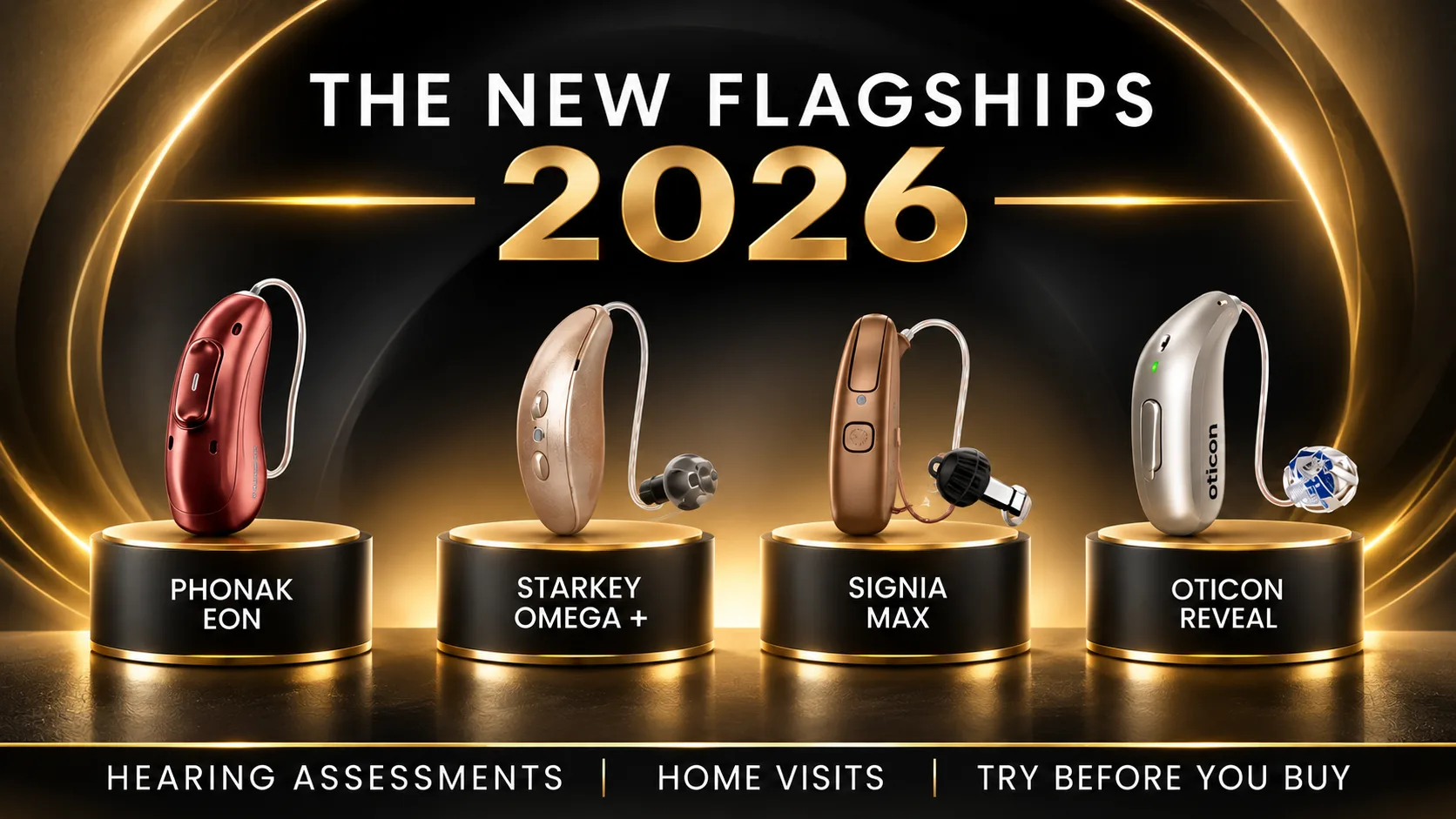
The new flagships: Oticon Reveal, Phonak EON, Signia MaX and Starkey Omega AI+
The 2026 flagships show how far DNN has come. Each takes a different route to the same goal: helping you follow speech in noise.
Oticon Reveal. Oticon calls Reveal the first hearing aid powered by “Dual AI”. Instead of one neural network doing everything, it runs two: a Speech AI that finds and lifts the voices around you, and a Context AI that keeps the surrounding sounds in balance so the world still feels natural. It’s the third generation of Oticon’s AI sound processing, building on the DNN that began with Oticon More. Oticon says Reveal produces a stronger brain response than its previous flagship, Oticon Intent, though that figure comes from Oticon’s own research.
Phonak EON. Phonak’s Sphere hearing aids were the first to carry a dedicated DNN chip. EON takes that idea further with a new, more power-efficient chip called HYPERSONIC, which runs Phonak’s DNN for separating speech from noise, called Spheric Speech Clarity 3.0. Phonak says this makes the Sphere hearing aid 25% smaller and 20% lighter than before, with up to 38 hours of battery life, and brings Sphere’s speech-in-noise system to more technology levels. EON also adds Auracast, the newer Bluetooth broadcast audio standard.
Signia MaX. Launched in August 2026, Signia’s MaX (Multi-adaptive Xperience) platform is built around four DNNs working together: one for speech, one for your own voice, one for the surrounding scene and one for noise. Signia calls this Acoustic Intelligence, and it’s aimed squarely at noisy group conversations. A new MaX chip supports it, and Signia says it has 54 times the processing power of the previous generation. It launched in one style, a rechargeable receiver-in-canal hearing aid, and most of the performance figures so far come from Signia’s own testing.
Starkey Omega AI+. Launched on 1 October 2026, Omega AI+ runs on Starkey’s new G4 Gen AI Neuro Processor and what Starkey calls a Quad DNN Architecture: four neural networks working together on different jobs, including directionality (Starkey’s DNN 360) and compression. The headline new feature is the DNN Dual Compressor, which Starkey describes as a first. It switches between fast and slow compression to balance speech clarity with natural comfort. Omega AI+ also adds Auracast and sleep tracking.
Different ideas, no single winner. Reveal aims to keep the whole sound scene and let your brain choose what to follow. EON aims to bring the voice in front of you forward. MaX splits the job across four specialised networks, and Omega AI+ takes neural networks all the way into compression. All are impressive, and many of the performance claims come from the manufacturers’ own testing. Which one feels best depends on you, and that’s exactly why we let you try them side by side.
How is DNN used in today’s hearing aids?
Modern DNN hearing aids use the technology in a few main ways:
- Separating speech from noise. The DNN has learnt the difference between a voice and the clatter of a busy pub, and can lift the speech you want to hear while reducing the noise you don’t.
- Recognising your listening environment. Instead of switching between a handful of pre-set programmes, the hearing aid constantly analyses the scene and adapts smoothly.
- Preserving the full sound scene. Older systems often worked by cutting noise out. Many newer designs aim to keep a natural sense of your surroundings while making speech clearer, which helps the brain do its job.
- Improving the sound of your own voice and of phone calls. Some brands apply deep learning to calls and streaming too.
And the result? In studies and in our own clinic experience, DNN-based hearing aids tend to help most in the situations people find hardest: noisy restaurants, family gatherings, group conversations and busy public places. It’s worth being honest, though. DNN is not magic.
It won’t restore normal hearing, and the benefit varies from person to person depending on your hearing loss, your lifestyle and how the aids are programmed. A brilliant chip in a badly fitted hearing aid is wasted.
Why an independent clinic matters
Here’s something the adverts won’t tell you. Every manufacturer says their AI is the best, and they would. A clinic that is owned by, or tied to, one manufacturer has a reason to recommend that manufacturer’s products, whether or not they are right for you. At Ross & Jamieson, we’re independent. That means:
- We fit hearing aids from all the current manufacturers. We aren’t tied to one brand, so there’s no brand we have to push.
- We recommend what suits you. Each brand takes a different approach to its AI, and each has strengths. Your hearing loss, your daily life, your budget and even the shape of your ears all affect which is the best match.
- We can compare them side by side. We can talk you through the real differences, in plain English, and arrange demonstrations so you can hear them for yourself.
- We can change course. If your first choice isn’t working, we can move to a different brand without it being a failure on our part.
- Expert fitting and aftercare. DNN hearing aids are powerful, but they still need to be set up to match your hearing and fine-tuned over time. That’s where an experienced audiologist makes the difference.
The best hearing aid isn’t the one with the most impressive AI on the box. It’s the one that’s right for your ears, programmed properly, and backed by someone you trust.
Try before you commit: road test your hearing aids
A clinic is a quiet, controlled place. Your life isn’t. That’s why we don’t ask you to choose hearing aids from a brochure or a demonstration alone. We let you road test them in the places you actually struggle, for 30 days.
Here’s why that matters. Every DNN is trained by its manufacturer on a huge library of sounds, and each company makes different choices about what to prioritise: how much background noise to clear, how natural to keep your surroundings, how to handle your own voice. Your brain then has to make sense of what comes through. And brains differ. Two people with the same hearing test can prefer completely different hearing aids, and no test booth can predict which. The only way to find out is to wear them.
Here’s how a road test works:
- We shortlist. Two or three hearing aids chosen to suit your hearing loss, lifestyle and budget.
- You live with them. Wear them at the pub, at family dinners, in the car, on the phone and in front of the TV.
- We fine-tune. A first fit is rarely the last word, so we adjust the settings as you tell us what you’re noticing.
- You choose with confidence. Keep the ones that work for you, or we try a different brand.
The best DNN hearing aid isn’t the one with the cleverest chip. It’s the one your own brain gets on with.
Thinking about DNN hearing aids in Uddingston?
If you live in Uddingston, Bothwell, Hamilton, Motherwell, East Kilbride, Blantyre, Bellshill or the wider Lanarkshire area, we’d love to help. Book a hearing test at our Uddingston or East Kilbride clinic and we’ll explain your results clearly, talk through the options, and show you how DNN hearing aids from different manufacturers compare, with no pressure to buy.